IrpiMedia è un periodico indipendente di giornalismo di inchiesta.
Scriviamo inchieste basate sui fatti e in profondità.
Aiutaci a garantire un’informazione libera e di pubblico interesse.
They are capable of vertical take-off and will be deployed along the migrant routes. No one knows their true purpose. What we do know from the case of Frontex, however, is concerning, as the drones might be used to facilitate pushbacks to Libya and Tunisia
At Villaggio Difesa, an event organised by the Ministry of Defence at Rome’s Circus Maximus in November 2024, the Guardia di Finanza put one of its newly acquired assets on display. It was jet-black, with the name of the law enforcement agency written across its wings in yellow.
At Villaggio Difesa, an event organised by the Ministry of Defence at Rome’s Circus Maximus in November 2024, the Guardia di Finanza put one of its newly acquired assets on display. It was jet-black, with the name of the law enforcement agency written across its wings in yellow.
In Breve
Italy’s Guardia di Finanza has purchased new vertical take-off drones, claiming that they will be used for maritime surveillance to combat illegal migration. They were paid for with EU funds, but we don’t know if they have been deployed yet, as our questions have received no answer. To learn more, one needs to look at Frontex, which has been using drones for much longer.
The GdF’s latest purchase comes at a time when aerial surveillance and the use of drones in particular, are an increasingly central element of the EU's border externalisation policies.
Since 2022, Frontex has flown planes and drones for at least 9,400 hours a year, detecting more than 195,000 migrants over the last five years. According to executive director Leijtens, however, yet «more surveillance» and «more drones» are needed.
Frontex aircraft are flying closer and closer to the Mediterranean’s southern shores, facilitating interceptions by the Tunisian and Libyan Coast Guards, who then return migrants to countries where human rights violations are commonplace.
The new GdF drones might do the same, by taking off directly from military vessels, unlike the Frontex ones. If confirmed, this would mark a significant development in EU border surveillance.
In 2022, Frontex executives stated that drones are needed «mainly to prevent the loss of human lives». Yet they are not used in a way that improves the migrants’ chances of being rescued after detection.
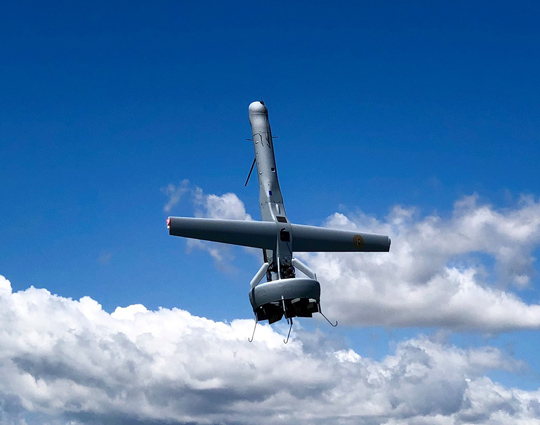
It is a V-BAT, a drone that can take off vertically from confined spaces and fly for several hours. The Guardia di Finanza did not have any at their disposal before. An institutional video explains that they are used for «air-sea patrolling», «to prevent and contrast illegal immigration»
The GdF’s latest purchase comes at a time when aerial surveillance, and particularly the use of drones, are an increasingly central element of the EU’s border externalisation policies. Several reports from journalists and NGOs have demonstrated that since 2020, the EU border patrol agency Frontex has been sharing data collected by drones outside of the EU perimeter. Since 2022, Frontex has flown airplanes and drones for at least 9,400 hours a year. The figure shows growth when compared to 2020 and previous years, and the trend does not look set to change. Last September, Frontex executive director Hans Leijtens asked the European Parliament for «more surveillance»: «We need more planes, helicopters»; «We need more drones», he said. Over the last five years, Frontex airplanes and drones have detected more than 195,000 migrants.
V-BAT and Radon X, the GdF’s new drones
With a 2.74-meter wingspan, the V-BAT can hit a ceiling of 4,500 metres and fly for more than eight hours at about 80 kilometres per hour. Its manufacturer, Martin UAV, describes it as «perfectly suited for maritime operations forces to quickly operate in support of dynamic mission sets at sea». In 2021, the company was acquired by Shield AI, a Silicon Valley-based defence and AI start-up that has recently reached a 5-billion-dollar valuation, mostly thanks to funding from US tech giant Palantir.
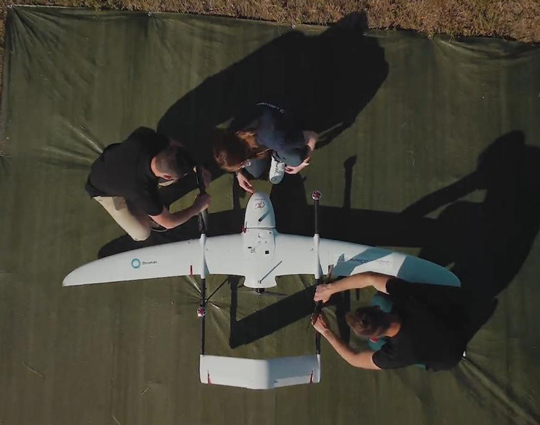
The GdF purchased the V-BAT through a contract awarded in 2021. In the same procurement, it also acquired another type of drone, the Radon X, manufactured by Italy’s Siralab Robotics. It is slightly smaller and has inferior performance compared to the V-BAT but, as the manufacturer explains on its website, is also capable of «landing or taking off in extremely small spaces such as those of a boat».
Vertical take-off makes the new drones compatible with another asset that was recently paid for by EU funds: the P.04 Osum patrol boat, built by Cantiere navale Vittoria (CNV). Commissioned in 2022 and about 60 metres long, «It is the largest ship in the history of the Guardia di Finanza’s naval service», according to an official video. «It is equipped with a take-off/landing area for a remotely-piloted system that significantly enhances its capabilities for long-range detection and intervention», the video continues. «It will coordinate the activities carried out to prevent and combat illegal immigration and other illegal trafficking at sea».
Prior to 2021, the Guardia di Finanza was only equipped with some thirty small rotary wing drones. The new, more powerful ones «will have to be capable of operating in mid-range scouting operations», as stated in the tender specifications. They will have to mount high-definition video cameras and infrared systems, thermal zoom cameras with automatic tracking and targeting capabilities, systems to identify and share the location of vessels (or other aircraft) nearby, as well as switchable navigation lights. They will be deployed «in the operational quadrant where most of the trafficking of irregular migrants (and other illegal trafficking at sea) occurs».
The exact number of these new drones is not clear: IrpiMedia has been able to determine that two V-BATs and three Radon Xs were purchased as part of a project within the 2014-2020 national programme of the EU Internal Security Fund. However, other documents suggest higher numbers of UAVs available to the GdF.
The GdF have confirmed that they have the drones identified by IrpiMedia, but stated in their email that «How the drones are used and the details of the individual operations are of a classified nature, as they are part of police investigation techniques, and therefore covered by confidentiality».
So far, the new drones have only been featured on public occasions, such as Villaggio Difesa in Rome or the celebrations for the 250th anniversary of the GdF which were held in Gaeta in July 2024. An article in the Ares Osservatorio Difesa website states that the V-BAT is supplied «to the air and sea operations command at Pratica di Mare», «the Catania-based air manoeuvre unit of the Messina air and sea group, and the Grottaglie air manoeuvre unit of the Taranto group». However, various sea rescue organisations said to IrpiMedia that they had never heard of or seen these new drone models
This new type of UAV was the subject of a Frontex test launched with Portugal and Italy in 2023, with drones in the same weight category as those supplied by Siralab to the Guardia di Finanza. They were chosen for their ability to take off and land vertically even in confined spaces, such as the deck of a patrol boat. Hence the interest of the agency, which wrote in documents for the trial that the employment of vertical take-off drones with up to 25 kg maximum take-off weight «has not been covered under present or past pilot project and represents a potential operational capability gap».
Aerial surveillance: the case of Frontex
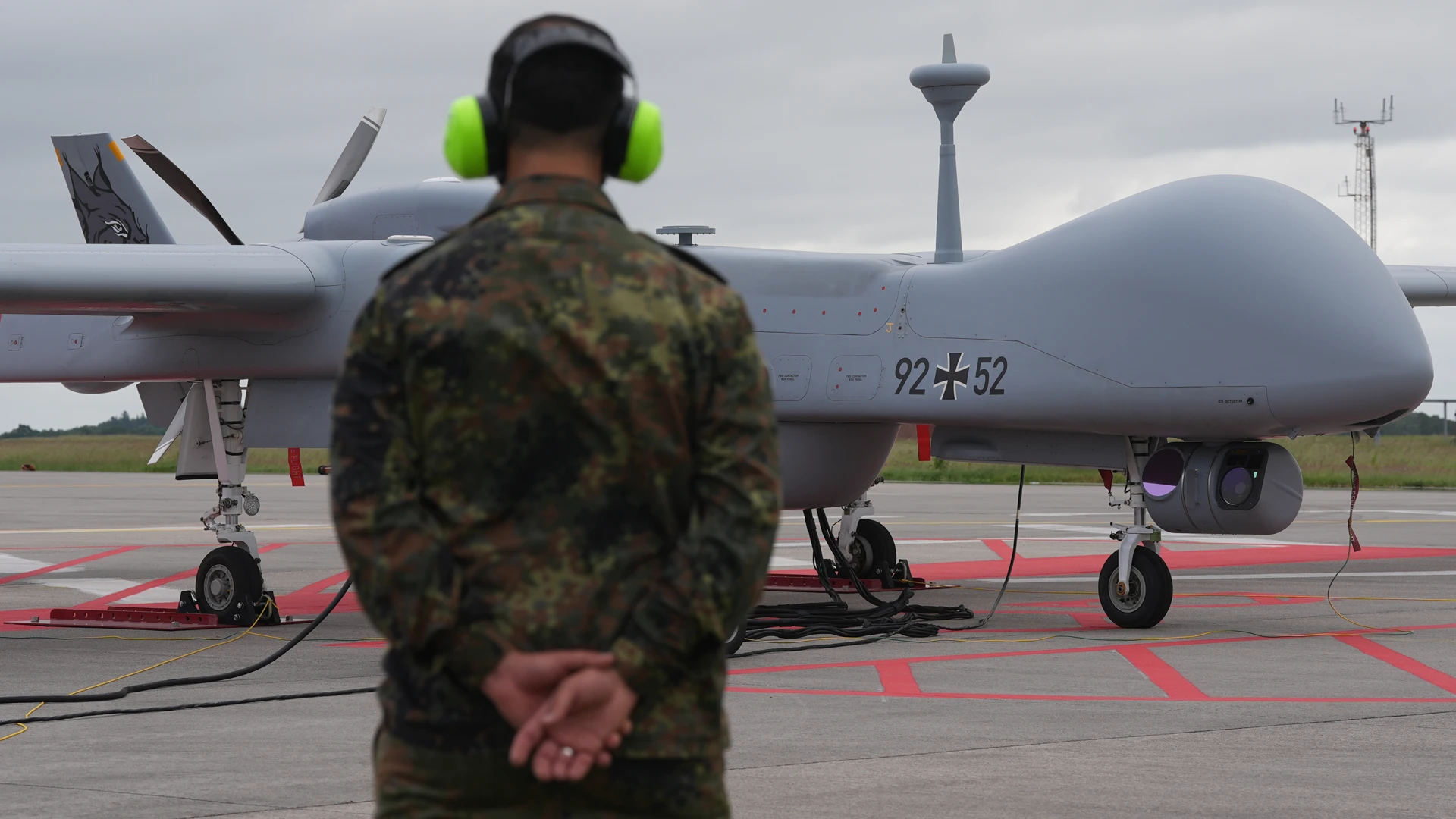
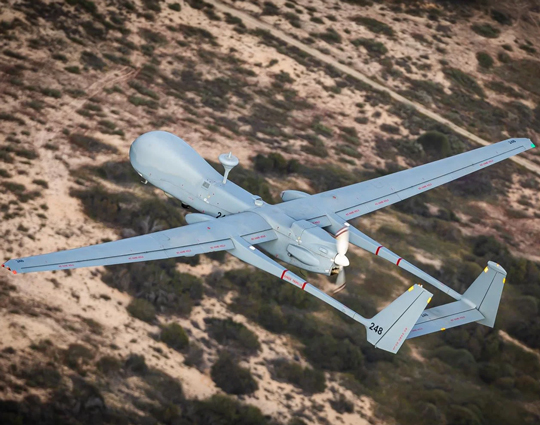
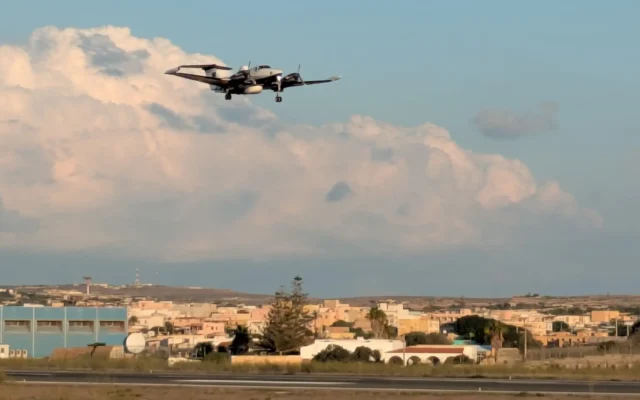
The only type of drone used by Frontex to date is the Heron, larger and more powerful than those purchased by the Guardia di Finanza, even though it requires a runway to take off (horizontally). According to Frontex documents, two such drones were active in 2023 while, as of December 2024, only Heron 1 was operational from the Luqa base in Malta. As of late 2024, Frontex’s aerial surveillance was ensured by ten manned aircraft, including several Eagles and Sparrows launched from Lamezia and Lampedusa
Eyes on the Mediterranean.
Comparison between the technical specs of drones used by the Guardia di Finanza and Frontex. The V-BAT and SR Radon X were purchased in 2021, while the Heron was first tested by Frontex in 2018.
In 2024, out of every 100 migrants crossing the Central Mediterranean, at least two died. The figure is lower compared to peaks in 2018 and 2019, but higher than in 2022 and 2023.
In 2024, Frontex assets carried out more than 10,800 flight hours, more than 6,200 of which related to operations based in Malta and Italy. Frontex aerial surveillance detected a total of over 33,000 migrants, with more than 30,000 at sea. The latest figure shows a drop from 2022 and 2023, partly because 2024 saw 239,000 detections recorded, compared to 380,000 in 2023 (the highest level since 2016). About 150,000 of these came from the central Mediterranean route. According to data from the International Organisation for Migration (IOM), the number of deaths along this route in 2024 was 1,669 (-32% from the previous year), but the drop in arrivals was more pronounced (-58%). This means that the mortality rate in the Central Mediterranean, i.e. the ratio of deaths along the route to the total number of people making the crossing, creased between 2024 and 2023.
What Frontex provides to EU countries is multifunctional aerial surveillance (MAS). Real-time video is shared with the agency’s European Monitoring Team, based in Warsaw and consisting of duty officers with different backgrounds. Additionally, information on vessels in distress «is immediately communicated to the competent Maritime Rescue Coordination Centre (MRCC) and for enhanced situational awareness to the other MRCCs operating in the area». All the material collected by drones and aircraft is used to provide a situational picture at the EU borders. For a more exhaustive picture, pre-frontier areas are also monitored, meaning the geographical areas beyond the external borders of the EU.
To give a practical example, this means that, when a Frontex drone spots a migrant boat in the central Mediterranean, it will alert the relevant Italian and Maltese authorities, as well as the Libyan or Tunisian ones. No other entities are involved, except the Member State authorities: it is their responsibility – and theirs alone – to coordinate the rescue operations.
However, the agency adds, in case human lives are in imminent danger, «Frontex Surveillance Aircrafts will relay a MAYDAY communication over the marine emergency channel for all ships to render assistance, including merchant vessels and NGOs in the area». This addendum is a crucial one.
Why the use of drones at EU borders is problematic
Over the years, Frontex has explained that it does not have a mandate to coordinate search and rescue operations, and that it follows international laws whenever issuing calls to alert. It has pointed out that any improper use of MAYDAY radio calls might create dangerous confusion, jeopardising yet more lives. In 2022, Aija Kalnaja (who was Frontex’s acting director at the time), in response to an MEP asking for more information on the agency’s use of drones, wrote that they help «to fight cross-border crime and illegal migration, and above all prevent loss of life at sea».
How many migrants cross the central Mediterranean. And how many don’t make it
In 2024, for every 100 migrants who crossed the central Mediterranean, at least two died. This figure is lower than the peaks in 2018 and 2019, but it is up from 2022 and 2023. As the data from 2019 show, fewer crossings are not matched by fewer deaths
Data: IrpiMedia processing of IOM data, Frontex | Jan 2025 | Created with Flourish
However, several independent inquiries have criticised how Frontex manages the information collected from aerial surveillance, questioning its ability to help save lives at sea. «Frontex should adopt and publish internal guidelines on how to react to maritime emergencies detected by Frontex’s aerial surveillance, including regarding the issuance of MAYDAY relays and possibly also other emergency signals», was the conclusion reached by the then European Ombudsman Emily O’Reilly, following her inquiry into the role of Frontex in the Pylos shipwreck of June 2023.
The #WithHumanity campaign, launched by Human Rights Watch in late 2024, calls on the agency to systematically transmit the location of boats in distress sighted by Frontex aircraft to NGO rescue organisations in the area. This is something that happens only sporadically. «There is absolutely nothing in international law that prohibits Frontex from directly notifying an NGO vessel in the area of a boat in distress», Judith Sunderland, Europe and Central Asia Director at Human Rights Watch, explained. Moreover, with the revision of its mandate in 2016, Frontex added another title to its name: the European Border and Coast Guard Agency. «Why then», Sunderland wonders, «is the agency not maximising the chances of rescuing the migrant boats it detects?»
To this day, in terms of aerial surveillance, sea rescue NGOs have to rely mainly on the information they receive from their drones: they launch them «to survey the sea looking for vessels in distress, or get more information when they receive an alert», said Philipp Borgers of SearchWing, a German NGO founded in 2017 that develops, build and supplies drones for NGOs’ SAR operations.
In 2020, Frontex detected a total 175 vessels in distress, or “SAR incidents”: «119 […] were located in the Libyan Search and Rescue Region and […] were communicated to the Libyan Rescue Coordination Centre». This was in the first year of the pandemic, when the flow of migrants had dropped considerably.
In 2021, in the Central Mediterranean alone, detections rose to 433, with 22,696 migrants involved. This number is slightly lower than the total number of migrants sighted by the Frontex in that year. The fate of these migrants is unknown. How many were rescued, how many landed in Italy or were taken back to Libya? How many died? In its reply to a question by German MEP Özlem Demirel (The Left), Frontex explained that it has «limited information on the number of actual search and rescue operations launched as a result of transmitting potential search and rescue cases to the competent and responsible Rescue Coordination Centres».
In “Airborne Complicity: Frontex Aerial Surveillance Enables Abuse“, a 2022 study conducted by Human Rights Watch and Border Forensics, Frontex aerial surveillance is regarded as «a central plank of the EU’s strategy to prevent migrants and asylum seekers from reaching Europe by boat […] an attempt by the EU to remove itself spatially, physically, and legally from its responsibilities». Through increased aerial surveillance, European authorities have progressively withdrawn Frontex and other EU vessels from the area, handed over responsibility to Libyan forces, and obstructed the vital work of nongovernmental rescue groups». The study established «a moderate and statistically significant correlation between its asset flights and the number of interceptions performed by the Libyan Coast Guard. On days when the assets fly more hours over its area of operation, the Libyan Coast Guard tends to intercept more vessels».
As much as both agencies insist that drones are «helping to save human lives», according to Chris Jones, executive director of the NGO Statewatch, the facts say otherwise: «We know that stopping migrants from reaching Italy is a priority for both Italy and the EU, and we know that one way to achieve this is by using drones to detect migrants and then send them back to Tunisia and Libya». It is up to Frontex and the Guardia di Finanza to dispel these concerns.
Hai informazioni su questa storia o su altri casi di abuso di potere?
Puoi inviarci documenti e segnalazioni in modo completamente sicuro e anonimo.
Le spese dell’agenzia europea per le frontiere in questo campo sono in crescita vertiginosa. Sono cruciali per consentire le intercettazioni dei migranti da parte della guardia costiera libica. E potrebbero aumentare ancora
La missione delle marine militari europee Irini ha modificato i suoi obiettivi. Ora il suo focus è fermare la “flotta ombra” nel Mediterraneo. Documenti e fonti confidenziali rivelano cosa stia dietro questa cambio di priorità
Dopo la forte affermazione di AfD nella regione della Germania Est, i timori e le riflessioni della comunità siriana e di chi lavora coi migranti: il Paese era già cambiato prima di queste elezioni, ma la situazione può peggiorare ancora
Israele finanziava la promozione sul motore di ricerca di una finta versione del documentario Naza. Su nostra segnalazione, Google ha dovuto riconoscere la violazione delle proprie regole
Il ruolo del cooperante delle Nazioni Unite, trovato morto nel 2020, è spesso stato derubricato a lavoro d’ufficio. In realtà, è stato decisivo per fare da tramite fra lo Stato colombiano e gli ex guerriglieri
In Sicilia, una multinazionale vuole costruire quattro parchi solari nella valle del Belice. A volerli sono anche i proprietari dei terreni. Chi ha fatto incontrare le due parti è un uomo senza particolare esperienza nel settore
Dal 1982 la "direttiva Seveso" serve a prevenire gli incidenti industriali. In Italia gli impianti sono circa un migliaio. Crisi climatica e transizione energetica sono le nuove sfide, ma servono risorse adeguate