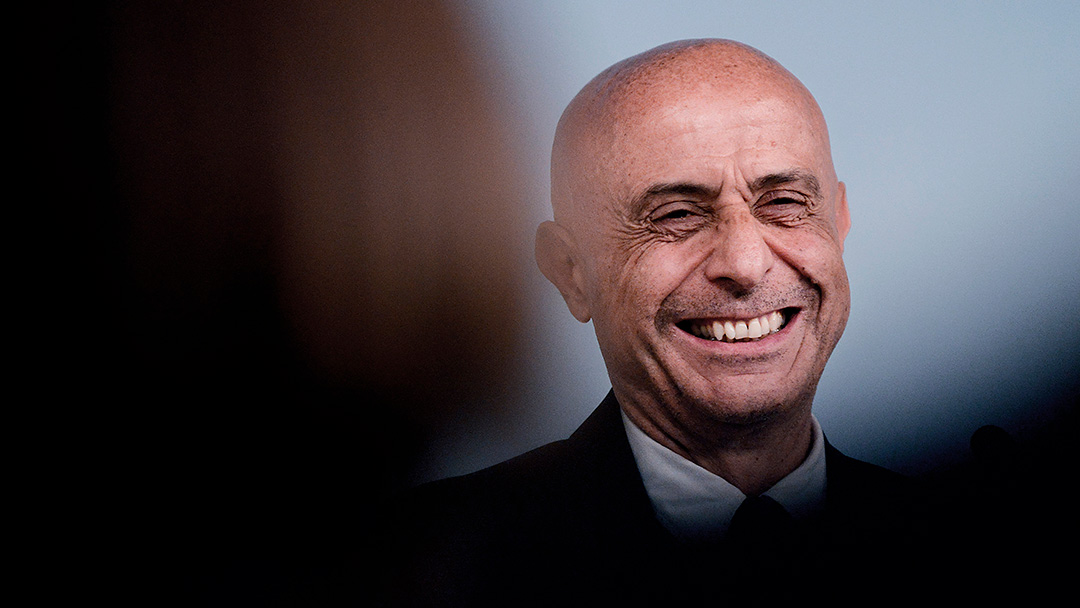
Defence, surveillance, intelligence, borders. Four keywords connecting the most important Italian company in the defence sector, Leonardo (formerly Finmeccanica), and the kingmaker of Italian politics in the field of intelligence: former Minister of the Interior Marco Minniti. A member of the Democratic Party, Minniti served as Secretary to the Prime Minister’s Office Cabinet with responsibility for intelligence services during governments led by Letta and Renzi. Marco Minniti is equally held in high esteem by the left and the right, for his deep knowledge of the universe of Italian intelligence and the structure of power of the armed forces.
It is no coincidence that the new foundation created by the Leonardo group, Med-Or, picked Minniti, now out of Parliament, as its president. Med-Or‘s mission is to expand the network of relations required to export the “Italian System” abroad and consolidate its positions. The choice of Minniti brings knowledge of the geopolitical contexts, which is vital for the sector, and a common vision shared by the diverse range of participants in the diplomatic and political network of Leonardo’s diverse universe.
Defence and relations
«The results for the first nine months are very positive.» Alessandro Profumo, CEO of Leonardo, is happy with the performance of the most important Italian defence company, which is 30% owned by the Ministry of Finance. The driver of the success is the military/government sector, which accounts for 87% of the group’s revenues.
In the Odyssey, Penelope endlessly wove a shroud to avoid having to remarry, in the hope that her husband Odysseus would return home. Hoping to remain one of the industry’s biggest players despite the pandemic, Leonardo weaves its own networh, made up of relationships with governments around the world and with Italian companies owned (and/or otherwise controlled) by Leonardo. This is the reason why the company’s military orders by foreign governments reached €9.2 billion, «a sharp growth over the first nine months of 2020,» states a November press release.
Since July 2021 a new think-tank has been weaving Leonardo’s web: the Med-Or foundation. Thanks to Med-Or, whose stated aim is to foster education, training, and cultural exchange, Minniti can continue to promote his political beliefs in another capacity. As a minister, he led proponents of increased surveillance in the Mediterranean; Border monitoring is among the main fields of interest of Minniti’s new employer, Leonardo.
Leonardo’s web: getting where institutions can’t
The letter begins with a formal tone: «Dear Sir,» (A more informal “dear Franco” was later added by pen). «The Leonardo Group – continues the letter undersigned by Chairman Marco Minniti – has recently set up a new Foundation called Med-Or, which I have the honour of chairing.» «Franco» is Franco Gabrielli, former head of Police and now undersecretary to the Presidency of the Council of Ministers. A similar letter was mailed to Luciana Lamorgese, Minniti’s successor at the Ministry of the Interior after Matteo Salvini’s short interlude, and Luigi Di Maio, the Minister of Foreign Affairs. They all participated, by invitation, in the Med-Or Day, held on July 20th, the day of the foundation’s launch.
«Since its very creation – Minniti continues -, the Foundation has pursued very ambitious objectives, and its vocation is to serve the national interest, to which, as you know, I have devoted a large part of my life.» The aim of Med-Or, a conjunction between the “Mediterranean” and the “Orient”, is to «encourage dialogue with those international players for whom Italy is a natural interlocutor» especially in the area that Minniti has repeatedly defined as the “Mediterranean quadrant”, i.e. the geopolitical area that extends from the Mediterranean to the Sahel and the Middle East. «You are certainly aware of the fact that almost all industrialised countries use this type of tool to underpin their relations, as I have been able to appreciate in my previous institutional experiences; the results are often very appreciable, and the objectives equally ambitious,» the former minister added.
Med-Or is a sort of “clearing house” for formal and institutional meetings, an incubator of relations available not only to Leonardo but also for the whole shaky Italian industrial apparatus. «Is there an Italian system?», the former minister asked in an interview with Libero in September 2020. The rhetorical question followed a reflection on Italian deeds in Libya, where Italy runs a hospital in Misrata, but the port is controlled by Turkey. The subtext was that Italy is unable to consolidate its leading positions and to assert its presence in multiple sectors by acting as a single entity.
Leonardo’s aim is to reach where institutions can’t. «Leonardo’s top management considers this initiative with particular interest, not only due to its contribution to the Group’s international relations, which will favour its strategic positioning but also because Med-Or aims to represent a heritage available to Italian institutions and to protect its values,» Minniti wrote in his invitation letter to Med-Or Day.
The foundation is supported by Leonardo – as its sole sponsor – with a Core Fund of € 120,000 and an additional donation amounting to approximately € 500,000 «to finance the initiatives currently underway (scholarships, higher education, internships, etc.)», Leonardo explains in a note to IrpiMedia.
«Foundations with similar characteristics to Med-Or are common mainly in English-speaking countries and in France. There are many examples,» the company continues, without, however, providing any specific names. «The vocation of a foundation like Med-Or is to have an open dialogue with Mediterranean countries, based on cultural exchanges,» it adds. The Med-Or strategic committee includes envoys from the Ministry of Foreign Affairs, the Ministry of the Interior, Economic Development, Defence and Finance; the Presidency of the Council of Ministers and the Federation of Italian Companies for Aerospace, Defence and Security (AIAD), a sector association of companies led by former MP and founder of Fratelli d’Italia, Guido Crosetto. Med-Or is not a state agency, but it looks like one. It is the flagship of diplomatic relations outside the Ministry of Foreign Affairs’ building: a network made of friendships, industrial relations, and cultural exchange projects.
«The fact that the Foundation has only one sponsor is not very common in think-tanks», Mattia Diletti, professor at La Sapienza University in Rome and author of I think tank (Farsi un idea) (Think-Thanks: a general overview), published by Il Mulino, told IrpiMedia. «In Med-Or, the network dimension is very actively supported. In political science, we talk about gatekeepers or policy entrepreneurs, i.e. people who drive other networks of stakeholders: when Minniti acts, he doesn’t just represent himself», Diletti added.
Minniti at Med-Or: intelligence, Niger, Libya and the friends from the Gulf
The first think-tank co-founded by Marco Minniti was ICSA, Intelligence Culture and Strategic Analysis, between 2009 and 2013, the year when he left office to become under-secretary of the Prime Minister’s Office (Prime Minister Enrico Letta) in charge of intelligence services. ICSA, which today is led by retired army general Leonardo Tricarico, deals with education and training in the field of intelligence; its first chairman was Francesco Cossiga, a former President of the Republic with a passion for intelligence services. Among all the foundations run as a “one-man company”, ICSA has been different since the very beginning, a collector of relations and skills in the specific field of defence and security.
The experience at the Ministry of the Interior contributed to corroborate Minniti’s reputation in geopolitical matters, and especially in Libya. Minniti has been a leading proponent of the outsourcing of border policing. The controversial policy was implemented in 2015, through the training of border guards and the handover or sale – depending on individual agreements – of surveillance technology to transit countries on the main migration routes to Europe. As Minister of the Interior, in February 2017 Minniti signed a Memorandum of Understanding with the government in Tripoli to fund the Libyan Coast Guard. Minniti also promoted the largely contested NGO code of conduct, which granted police officers rights to board NGO ships to gather intelligence. Ultimately, Minniti brokered a peace agreement between 72 tribes in Fezzan, Libya’s southern region, hoping to pacify Libya. Minniti said his goal was to create «a Libyan border patrol to guard 5,000 kilometres of Libya’s southern borders.»
On that border, the surveillance system was operated by Selex, which was then part of the Finmeccanica group (now Leonardo). «Our company manufactures the sensors for border monitoring but we know perfectly well that without the desert tribes those borders can’t be monitored. This is because the human factor is indispensable since no technology can completely cancel out the importance of the human factor»: these were Minniti’s words on October 29th, the day on which Leonardo, through Med-Or, donated 50 respirators to Niger to help the country deal with the Covid-19 pandemic. «We know that a decisive challenge for the overall security of the Mediterranean and the entire planet is being played out in the Sahel. The Sahel is crossed by tensions and instability: however, in what we have called “Europe’s Southern border” – a definition that arose scandal when we first used it and has now become commonplace – a crucial game is being played for Europe’s security, for the fight against terrorism and the issue of migratory flows», the chairman of Med-Or commented.
On the occasion of the launch of Med-Or, the Vice-President of Libya, Abdullah al Lafi, sent a warm message of good wishes «to our friend Marco». Interviewed in April 2021 by Repubblica, al Lafi said: «The most important thing for us is to provide support in ensuring the security of the Mediterranean, and in stopping illegal immigration». With this in mind, the country is discussing the purchase of helicopters to patrol the sea area in which rescue operations are under the responsibility of Libya, as well as the creation of a helicopter assembly centre on site.
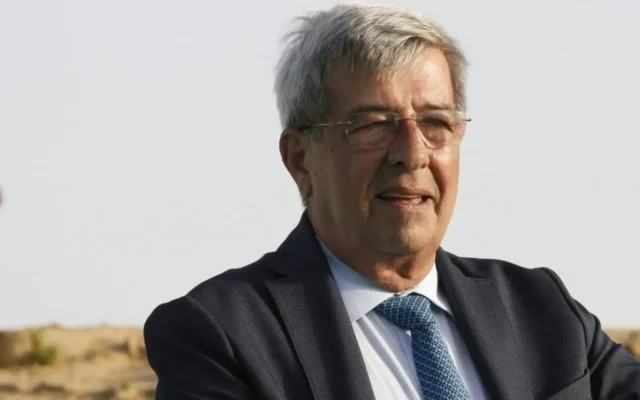
The launch of Med-Or was also attended by Dimitris Avramopoulos, the former European Commissioner for Migration when Minniti was Minister of the Interior. Another attendee was Mohamed Abdirizak, Somalia’s foreign minister, but also a businessman and former coordinator of Mossad operations on prisoners of war and victims of armed action under Benjamin Netanyahu’s first government David Meidan (who said he was «honoured to be part of the Med-Or Leonardo initiative» and thanked Minniti for the trust).
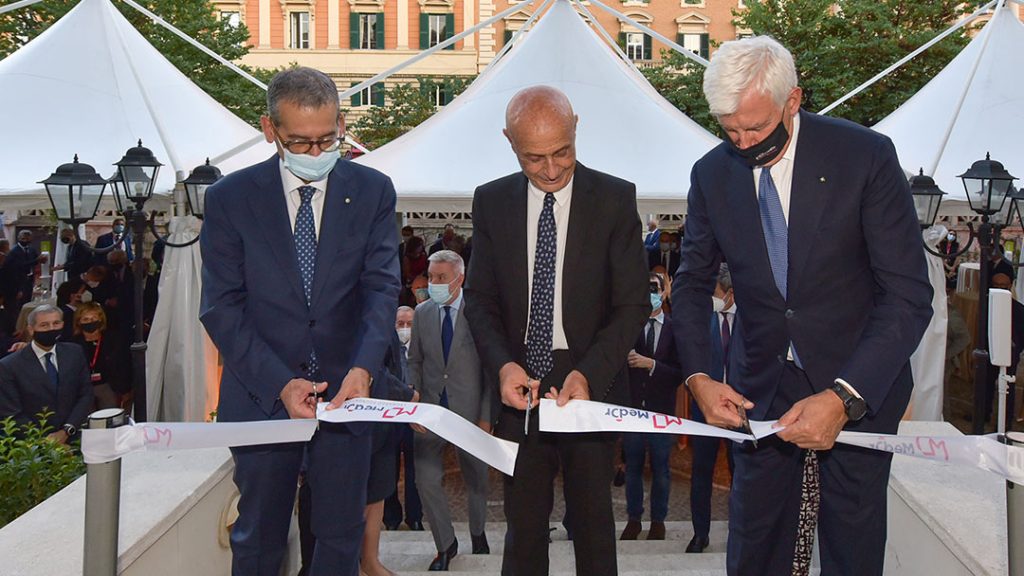
These attendees were joined by three ministers of Gulf countries: Abdullatif bin Rashid Al Zayani, Minister of Foreign Affairs of Bahrain; Sheikh Mohammed bin Abdulrahman Al-Thani, Deputy Prime Minister and Minister of Foreign Affairs of Qatar; and Hamad bin Mohammed Al Sheikh, Minister of Education of Saudi Arabia.
These people all personally thanked Minniti for the invitation to take part in Med-Or. They all represent countries with whom Leonardo has consolidated relations. In Bahrain, which recognized Israel as a nation state in 2020, Leonardo operates contracts for civil and military air traffic management, the supply of ships, and the Navy’s radar tracking system. In 2021, in Qatar, Leonardo received an order for the provision of training courses for operators of the Qatar Computing Research Institute against hacker attacks, it provides ships and helicopters. In Saudi Arabia, Leonardo has historical supplies of aircraft and warships.
Leonardo and his daughters
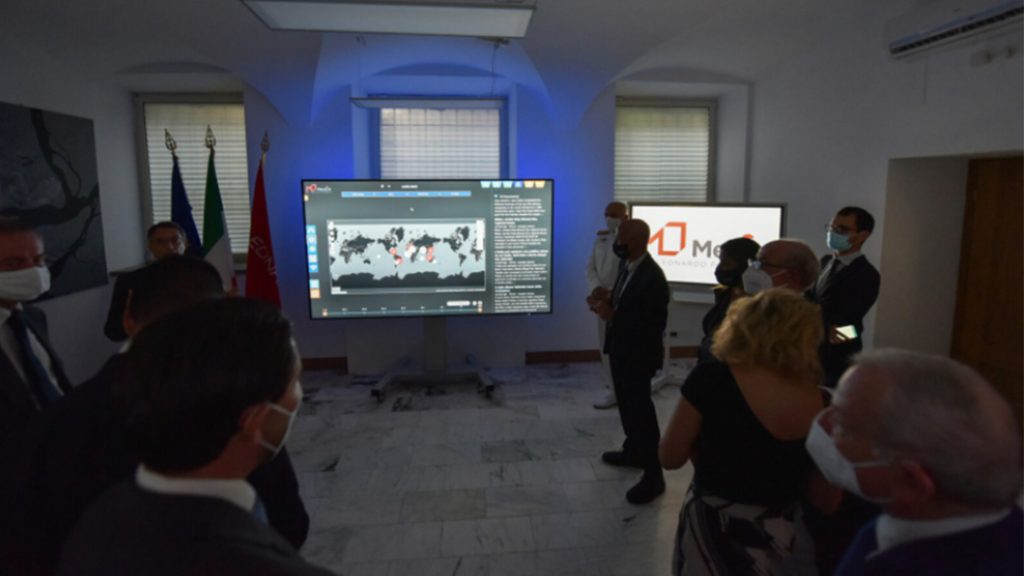
One of Leonardo’s strengths is its wide range of stakes in the share capital of companies in the defence and security sector. Some of these connections are also established by memoranda of understanding. For example, at the beginning of November Leonardo signed an agreement with Elettronica Spa – the company that controls the protagonist of the previous episodes of #Surveillances, Cy4gate -, «aimed at consolidating and strengthening Leonardo’s core business,» as outlined by CEO Alessandro Profumo. In essence, the agreement provides for joint participation in international projects. «On the opening day, Med-Or representatives showed guests its analysis centre, based on open sources and aimed at improving the understanding of the debate and the social and cultural dynamics of the countries of interest,» Leonardo explained to IrpiMedia.
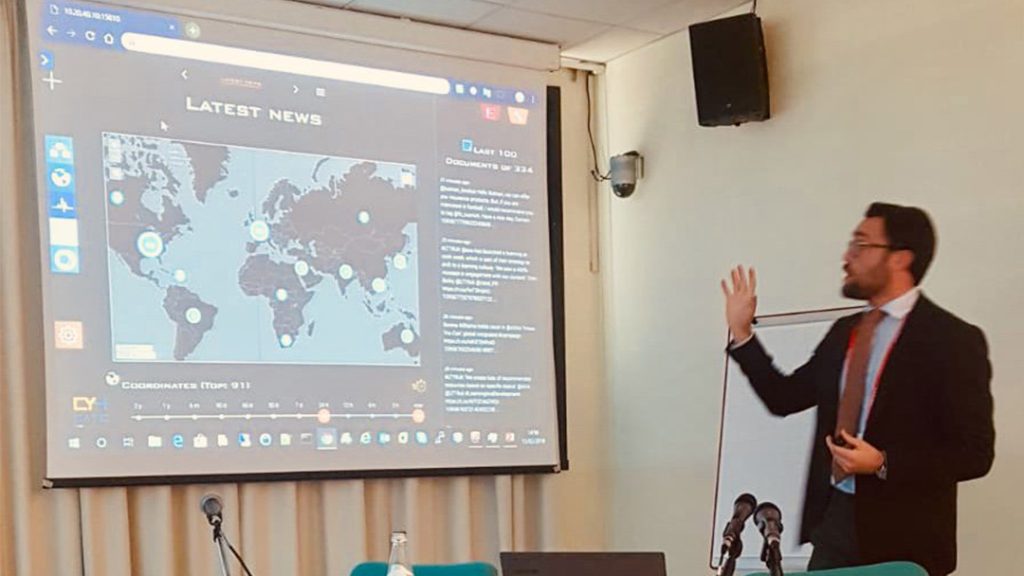
The software on the screen appears to be the same as the one produced by Cy4gate: on the screen, you can see a customised version, with the Med-Or logo, of an information dashboard identical to the dashboard of AMICO (an acronym for Advanced Multimedia Information Cockpit). The system allows access to documents and information collected online from so-called “open sources” such as social networks, public databases, or press reviews. Metro first reported on it in 2018, explaining that the product is «developed by Leonardo SpA and Rome-based Cy4gate». AMICO can interact with other software developed by Cy4gate. As outlined in a series of slides released following a meeting last October, the right-hand column of the AMICO dashboard may host documents from another product, QUIPO, described by the company as «the platform developed by Cy4gate to support intelligence analysts». Med-Or, however, «does not use QUIPO software», Leonardo replies.
In an interview released in July 2021 to the Telos blog, Minniti mentioned two issues related to health security when speaking of Med-Or’s interests: «The first is Health Intelligence, an area in which Leonardo has the necessary know-how. The other is Health Surveillance, that is, monitoring the progress of the pandemic». «The epidemic – Leonardo added in his answers to IrpiMedia – has highlighted how crucial the issue of managing health emergencies is. The epidemic has highlighted the difficulties of systems that do not have systems for monitoring (health surveillance) the development of the epidemiological situation. Italy can be a reference for these countries, to improve their ability to manage their own complexities». This same topic has also been the focus of Cy4gate itself, which has developed HITS, a contact tracking software.
Leonardo’s web in the history of think-tanks
Think-tanks like Med-Or are an invention of post-World War II American politics in the wake, as sociologist Mattia Diletti writes, of the «hope – almost always shattered – that knowledge, doctrine, knowledge or rationality will influence the actions of rulers and institutions». In the United States, think-tanks have many stakeholders, and scholar Robert Kent Weave has categorised them into three models: «Universities without students», i.e. training centres that make up for the shortcomings of the parties; research and development centres that live off public funding (one name for all: Rand Corporation, the largest think-tank in the world, whose budget ranges between 200 and 250 million a year and million-dollar commissions mainly from the Department of Defence) or political agora, where ideas and projects with ideological connotations are formed (partisan think-tanks). All American-style think-tanks «act in the gap between politics, industry and private stakeholders,» Diletti told IrpiMedia. «They generally rely on a multiplicity of donors, which allows them more independence.»
In Europe, these organisations are smaller. They have emerged mostly in Britain and Germany, where they are often created in the orbit of power centres where either foreign or economic policies are studied. In France, the French Institute of International Relations (IFRI), for example, is an organisation counting dozens of partners and funders, whose board includes former state councillors, academics, managers of Renault, L’Oreal and Burelle (a manufacturer of plastic products), bankers, and public officials. Their goal (on both sides of the Ocean) is to create positive interactions between important national companies, academia, and government. In other words, they «are systemic.» In Europe, «personal think-tanks» are also very successful: they act as manoeuvring spaces for political leaders who rely on their network of relations and their authoritativeness. They are often led by former politicians, such as Tony Blair or Gerhard Schröder.
In Italy, “one-man company” foundations, as former socialist minister Gianni De Michelis once called them, are particularly trendy. These are think-tanks created to promote personal leadership: «The Italian environment is more modest; our economy does not have big system stakeholders. Our big players are state or parastatal bodies», Mattia Diletti added, clearly referring to Eni and Leonardo.
The latter explained to IrpiMedia that it «has a duty to maintain relations with the countries in which it operates, beyond merely trade-related relationships. Med-Or, as it clearly emerges from its Statute, does not deal with Procurement. Its mission is to build a dialogue based on culture and the exchange of knowledge and skills. Throughout Med-Or, Leonardo intends to start a new partnership with an enlarged Mediterranean area». In short, weaving a web.
Among the concrete actions carried out so far, there are analyses and researches signed by journalists and academics published on the website and the opening of a partnership between the Mohammed VI University of Rabat, in Morocco, and Luiss University of Rome, through which the first three scholarships for Moroccan students have been financed.