Criminalising social struggles and dissent as an instrument of political action: according to several experts, this is the true goal of the security laws pushed by Giorgia Meloni’s government, starting with the security bill that was approved last June. But the measure, increasing penalties and strengthening investigative techniques, comes after years of normalising stakeouts, wiretaps, spyware, and undercover ops, all in the name of greater security. The real goal was not to bring criminals to justice, but to monitor and map activist groups and, now, even political parties.
The government wants to criminalise social struggles
The security bill is the culmination of a year-long process that began with judicial investigations. Primary targets are NGO workers, housing rights activists, and anarchists
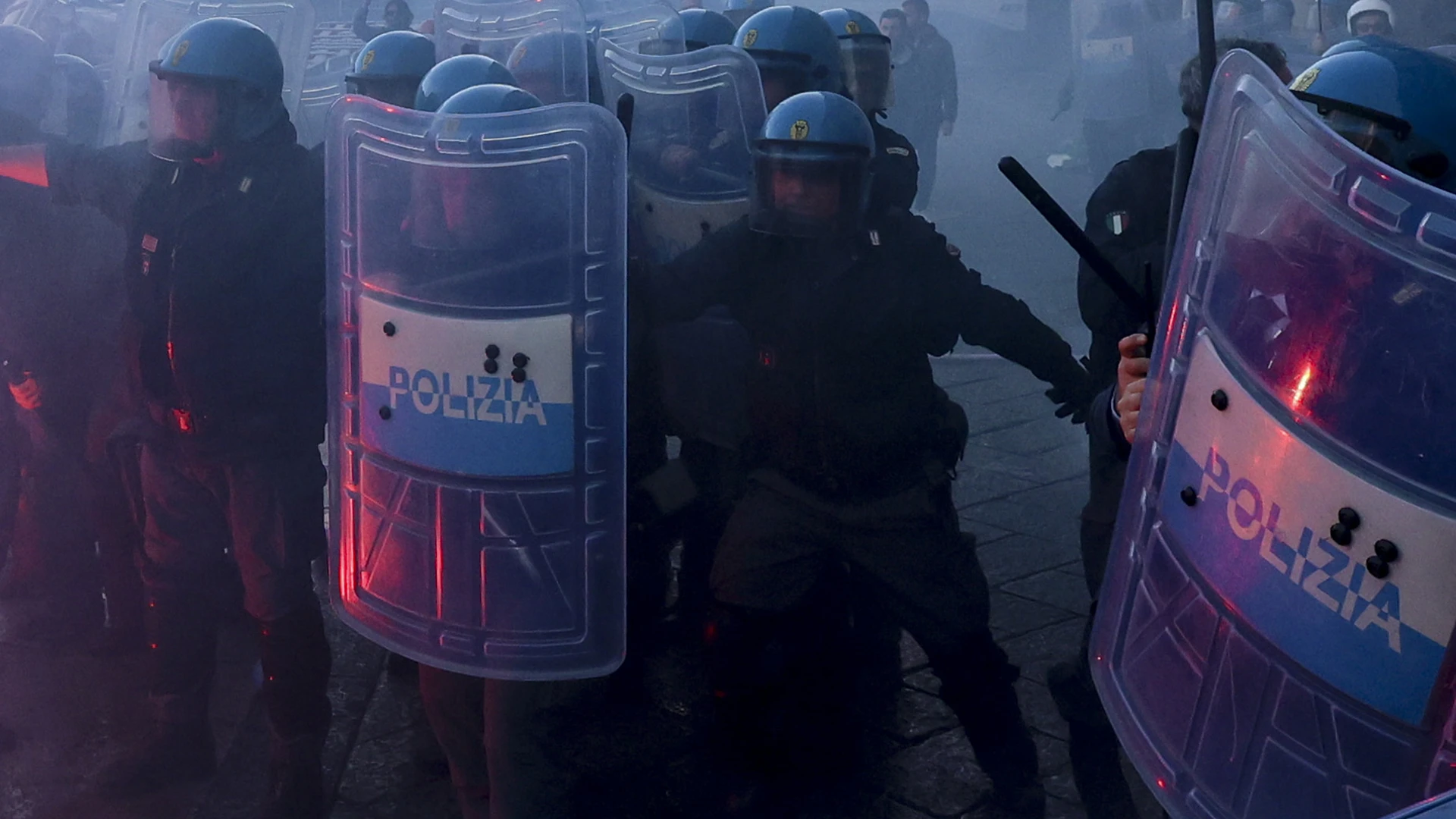
The real goal was not to bring criminals to justice, but to monitor and map activist groups and, now, even political parties. The latest instance involved the five police officers who infiltrated the meetings of Potere al popolo, a monitoring operation of a political group that was first revealed by Fanpage, and eventually acknowledged by the undersecretary of state, Emanuele Prisco. On July 4th, Prisco said before the Parliament the operation was justified by the need to «strengthen information tools to prevent disturbances to public order and security, and the criminal conduct that derives from them», He added: «These are ordinary activities for the police force that have always been carried out in the past».
Before the investigations promoted by the Ministry of the Interior and the police, it was the public prosecutors’ offices that paved the way for the surveillance of activists and humanitarian organisations. The pretext is to investigate crimes that justify the use of an entire arsenal of wiretaps, including bugs and spyware. This is what emerged from IrpiMedia’s analysis of the judicial papers of three proceedings that resulted in the main charges being dropped, invalidating the assumptions that warranted such intrusive investigative techniques.
Ultimately, the lives of those investigated were placed under a magnifying glass once reserved for the worst type of criminals, and minutely scrutinised to map out activist and anarchist groups, according to the conclusions reached by some of the judges. With the approval of the security bill, these activities will become increasingly simple and automatic.
Background to the security bill: three cases
The first case is the maxi-investigation Iuventa, which saw the Trapani public prosecutor investigate the NGOs Jugend Rettet, Save the Children and Doctors Without Borders for aiding and abetting illegal immigration. In April 2024, the court ruled to dismiss the charges against the crew members; the judge for the preliminary hearing wrote of a “partial evidentiary context”. The Iuventa crew members were working with migrants, a category for which the security bill has created a new crime: rioting in detention facilities.
The second case is the investigation against nine members of the Housing Committee of the Giambellino neighbourhood, in Milan, viewed by the prosecutors to be a criminal association aimed at the illegal occupation of public housing. After a conviction in the first instance, in December 2024 the Court of Appeal dropped the main charges as there was no case, and issued a new ruling for resisting arrest and other minor offences, which carry up to one year in prison. Again, the new security bill introduces a new crime for activists: arbitrary occupation of a residential building.
The third case – a slightly different story – is the Scintilla operation by the Turin Digos (2019). The investigation resulted in the indictment of 18 anarchists charged with “subversive association”, i.e. the promotion and establishment of «associations aimed at and capable of violently subverting the economic or social order constituted in the State». All defendants were acquitted of subversion charges in both the first and second instance. Three were entenced on appeal for possession of explosives, conspiracy to set fire to a detention facility and defilement. In this case, the criminal code was amended to make the mere possession of instructions to produce explosive material a criminal offence.
In all three proceedings analysed by IrpiMedia, the judicial police employed surveillance technologies that were once allowed only for a restricted range of crimes, and subject to a rigorous authorisation process to safeguard constitutional protections. It started with surveillance and wiretapping, which has been prevalent in Italy since the 1980s, especially in the fight against mafia-type criminal organisations.
Then, in the 2000s, investigative techniques were strengthened with the analysis of suspects’ browsing habits, and finally with the use of spyware, which is now routinely in the news. Unlike normal eavesdropping (in which an operator listens in on a subject’s phone calls), spyware is a window into a target’s device – normally a smartphone – allowing access to its content (messages, e-mails, photos) as well as remote control over its microphone and camera. It is an extremely invasive technique, like hiding inside a person’s pocket and following their every move.
Mapping out social conflict
«At the time of the investigation, the real focus was on doing intelligence work. The wireteps were used to map the people involved in the rescue operations at sea, using tools that belong to the anti-mafia activity». The attorney Stefano Greco defended Médecins Sans Frontières during the trial that followed the Iuventa investigation. He employed a metaphor to explain the decision to use spyware and wiretaps against the NGOs accused of abetting illegal immigration: «Using a cannon, instead of a rifle, to kill a gnat».
Originating in 2016, the Iuventa investigation was a major step towards the criminalisation of the NGOs rescuing migrants at sea. This process was spearheaded by the Trapani prosecutor’s office (Iuventa), and by Catania’s chief prosecutor Carmelo Zuccaro. At the time, the press was already divided between supporters and critics of the prosecutor, who said he was in possession of «direct conversations, in Arabic, between people on the mainland in Libya and representatives of NGOs claiming to be there to rescue migrants», he explained in an interview with Repubblica.
The prosecutor had set up a special team, and, as early as in 2017, was called for the investigation to be expedited by «tapping the satellite phones used to request rescue». These, Zuccaro said, would have the advantage of preceding the moment of rescue at sea. For this reason, the prosecutor called for more investment in radio intercepts.
Eventually, invasive investigative techniques were used to conduct the investigation: not only classic wiretapping, but also undercover agents on board ships, and spyware that infected the activists’ smartphones. Given the lack of phone service when sailing offshore, bugs were also placed on the ship’s bridge to listen in on the conversations of the crew while at sea. Meetings in the Trapani headquarters of Médecins sans Frontières were also bugged, as well as lawyers and reporters covering the issue. As early as 2021, the National Council of the Bar (Cnf) had stigmatised in a statement «the repeated violation of secrecy and confidentiality of conversations of the defending lawyers concerning their defence strategies».
At Giambellino, between 2014 and 2018, activists of the Housing Committee occupied council houses that had remained vacant. It was the Committee’s response to the city’s pressing housing crisis, which has only worsened in the 10 years since.
Defence lawyers Mauro Straini and Eugenio Losco therefore tried to convince the first instance judge to dismiss the charge of criminal conspiracy. For the crime to occur, it must have been committed by at least three people and must involve some form of profit for the organisation. Despite the fact that the members of the Committee had been identified by the Carabinieri during their investigation, and that their phone data was unencrypted, the seriousness of the charge persuaded the judge for preliminary investigations to approve the tapping of 40 phone numbers, between October 2016 and April 2017. The new security bill always allows wiretapping when there are allegations of illegal occupation.
In this case, although wiretaps were admitted as evidence, they were not enough to support the charges of criminal conspiracy during the appeal trial. The second instance judges pointed out that the occupation of public housing properties was «quite different from a criminal conspiracy to commit an indefinite number of offences in a ‘vast criminal programme’», as the prosecution had claimed.
The third case, resulting from the Scintilla operation in Turin, differs slightly from the previous two, as no crimes of solidarity were investigated. It started from the discovery of about twenty explosive packages bound for various Italian cities, targeting companies involved in the management of the CPR detention centres.
The judicial police identified the Asilo occupato squat in Turin as the source of the planned attacks, and law enforcement officers proceeded to evict the building in 2019.
«We have always said that the incidents were not attributable to an organised group, let alone an organised group from Turin» the anarchists’ defence lawyer Claudio Novaro commented to RAI, immediately after his clients were acquitted of subversion charges.
According to Novaro, the seriousness of the charges gave the authorities the grounds for evicting the squat and wiretapping the suspects, «a pretext for continuous surveillance of subjects belonging to certain political areas, monitoring their conduct and their dealings», Novaro wrote in 2019 on the blog Volere la luna.
What emerged from the trials analysed by IrpiMedia does not mean that wiretapping is not crucial when investigating mafia organisations. «The anti-mafia method» Franco Roberti, Attorney General for the National Anti-Mafia Directorate (Dna) 2013-2017, explained to IrpiMedia, «is a system based mainly on wiretapping, the primary tool in criminal investigations, because it is objective». He added: «It has worked in a huge number of cases over the last 30 years, and this is also confirmed by the convictions that followed the trials». Moreover, wiretaps, like any investigative activity, are always authorised by a judge who «must assess the evidence on the basis of which he is requested to authorise the interception of one or more persons. Whether the assessment is correct, it depends on the case», explained Roberti, who was also a MEP with the Democratic Party until 2024. «To a lesser extent», he added, «the anti-mafia method has also worked against terrorism». The issue, however, is to understand when it becomes disproportionate and unnecessary.
What remains of the fight for housing and migrants
Despite the acquittals, the criminal proceedings against the NGOs in the Mediterranean, the Giambellino Housing Committee and the Turin anarchists have had significant effects on the communities and the causes of the activist groups.
«The first casualty was the hard-built relationship between the NGOs and the Italian Coast Guard», said Stefano Greco, Msf’s lawyer during the trial that followed the Iuventa investigation. «The second casualty», he added, «were the NGOs themselves: in 2016, the Italian media described them as ‘sea angels’, which then became ‘sea taxis’ for migrants». Msf’s 2017 campaign saw a 7% loss (-4 million euro) on the collection of individual donations compared to the previous year, the Corriere della sera reported.
In the case of Giambellino, specifically, «a residents’ association was falsely painted as a criminal phenomenon, a political community portrayed as a criminal organisation, despite the fact that there has always been solidarity against evictions in the past, as well as solidarity with the occupiers, particularly in deprived neighbourhoods» explained defence lawyer Eugenio Losco. The Giambellino Committee was one of the many groups that had long advocated for more social housing in Milan, where spaces are often vacant because they are either too small or in need of renovation. The trial revealed the Committee’s mission to serve the community, including a host of activities that were cut short as soon as the investigations against its members began.
In Turin, after the eviction, the Asilo occupato squat on Via Alessandria 12 – in the Aurora district – is still awaiting redevelopment. Several student dorms and a sports centre have been built in the area over the last five years.
From 1995 to 2019, Asilo occupato was one of Turin’s anarchist strongholds and is now in a state of neglect. A change may be in sight, however: since 2025, after a few years of total stagnation, the municipality has started to acknowledge petitions calling for the recognition of several occupied spaces as “a common good” to be managed jointly with the organisations, including Askatasuna, that managed the former squat on via Alessandrini.
Investigations always have consequences. It is up to prosecutors to carry them out, and up to the judges to assess their outcomes. And yet, the initiative of the security bill may introduce legal provisions that are disproportionate to the true extent of the threats that it purports to address, and that prosecutors will have to investigate. Those who have criticised the bill view it as the sign of a “securitarian” drift in the government. The new lay may end up targeting those citizens and social organisations that have been actively fulfilling the duties to political, economic and social solidarity, enshrined more than seventy years ago in Article 2 of the Italian Constitution.
Hai informazioni su questa storia o su altri casi di abuso di potere?
Puoi inviarci documenti e segnalazioni in modo completamente sicuro e anonimo.
Invia la tua segnalazione




Altri contenuti
 Focus
Seveso, dal disastro alla legge
Dal 1982 la "direttiva Seveso" serve a prevenire gli incidenti industriali. In Italia gli impianti sono circa un migliaio. Crisi climatica e transizione energetica sono le nuove sfide, ma servono risorse adeguate
-
Tecnologia e Controllo
Sfruttati e sorvegliati. Come lavorano i data worker della società che addestra l’IA
 Focus
-
 Focus
-
 Focus
-
 Focus
-
 Focus
-
 Focus